
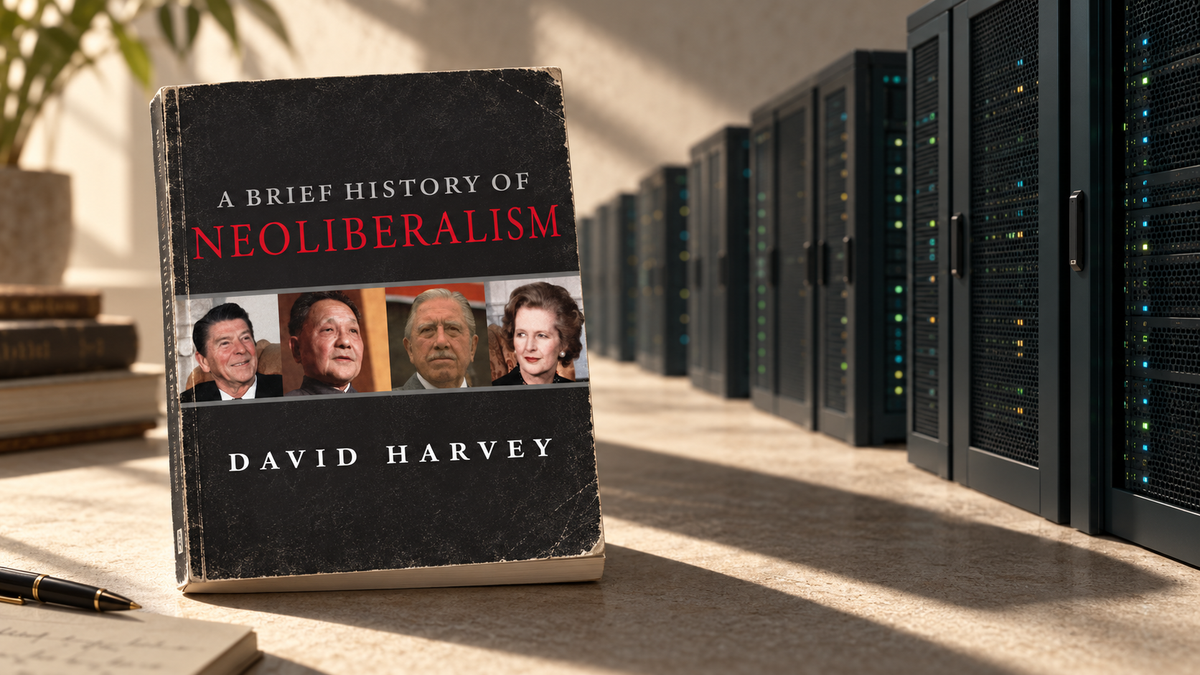
The generally accepted story of neoliberalism is that it peaked in the 1980s and 1990s and then declined. But it is also widely agreed that neoliberalism did not die. The ideology's fundamentalist commitment to free markets occasionally continues to attract new devotees, such as Milei in Argentina. And even in countries where it is no longer explicitly proposed, such as the UK, the structures that neoliberalism built, and the rubble of what it destroyed, continue to tower over people in the form of privatised natural monopolies, weakened organised labour and extreme concentrations of wealth.
This claimed persistence is sufficient reason to be interested in David Harvey’s A Brief History of Neoliberalism despite its age (it was first published in 2005). But if I had a chance to interview Harvey, I’d also seek his views on my own topic of interest: how has the UK, which happens to be the land of Harvey’s birth, ended up being so "worryingly comfortable" in its dependence on foreign providers of digital infrastructure? And how can it push for greater sovereignty?
Knowing how he writes, I suspect Harvey would at first give a sweeping answer: neoliberalism killed not only the publicly-owned IT infrastructure that could have avoided interdependence, but also the very idea that such infrastructure ought to be publicly owned in the first place. Neoliberalism changed the boundaries of what governments imagined themselves capable of owning, and what the voting public imagined could belong to them.
The assumptions we make about sovereignty and public ownership are getting more urgent as we approach the AI era, when chips, data centres and language models are looking less like ordinary products or services and more like the basic infrastructure on which much of the economy — and perhaps the state itself — will depend. If UK solutions to AI sovereignty issues are to be designed under the shadow of neoliberalism, then it’s important to begin by acknowledging this.
From Liberalism to Neoliberalism
Where Harvey’s book really shines is in convincing someone like me, who is suspicious of “-isms” in general, that neoliberalism is even a thing. In my personal and business life, I try to avoid applying -isms to individual people, prejudging that if they believe in X then they will also believe in Y, because I fear this would say more about me than about them. But Harvey does a good job of showing that, at a macro level, groups and institutions — such as political parties and governments, banks and supranational organisations like the IMF — do indeed organise themselves around predictable clusters of linked ideas.
The first such pattern in Harvey’s story is what’s called embedded liberalism. This was the post-war settlement in which Western governments retained liberal commitments to private property, markets and individual freedoms, but accepted that these had to operate within — be “embedded” in — institutions designed to protect the common good, including welfare states, full-employment policies, collective bargaining and regulation.
Harvey quotes US President Roosevelt’s 1935 message to Congress as an important precursor to embedded liberalism: to avoid a repeat of the Great Depression, Roosevelt said that Americans must “forswear that conception of the acquisition of wealth which, through excessive profits, creates undue private power.” Among the freedoms granted to every individual, Roosevelt was concerned that freedom from poverty and hunger was critical, and state power should be used to allocate resources to achieve that.
Embedded liberalism was associated with strong economic and social progress after World War II, but the many crises of the 1970s gave figures like Reagan and Thatcher an opening to propose a different settlement. Neoliberalism kept the ‘liberalism’ while largely dropping the ‘embedded’: freedom to trade and accumulate property took precedence over guarantees of ‘freedom from want’. Enterprise and growth would offer a better route out of poverty than redistribution; lower taxes on capital and fewer restrictions on employers and trade would encourage investment and hiring; and privatisation would allow competition and price signals to guide resources more efficiently than government ownership and direction.
From neoliberalism to what we have now
According to Harvey, neoliberalism won the argument: its prescriptions became influential across many governments and international financial institutions. However, its results were disappointing. It failed to restore the growth rates enjoyed during the post-war period. It primarily succeeded in enriching just a few corners of society, such as the financial sector, while concentrating wealth and power among economic elites. It was countries that followed patterns other than raw neoliberalism that led in terms of growth: most notably China, which followed its own particular pattern (“neoliberalism with Chinese characteristics” as Harvey puts it), and which managed to lift an estimated 800 million people out of poverty. Other countries that managed to avoid the most extreme forms of neoliberalism, such as Poland, also fared better.
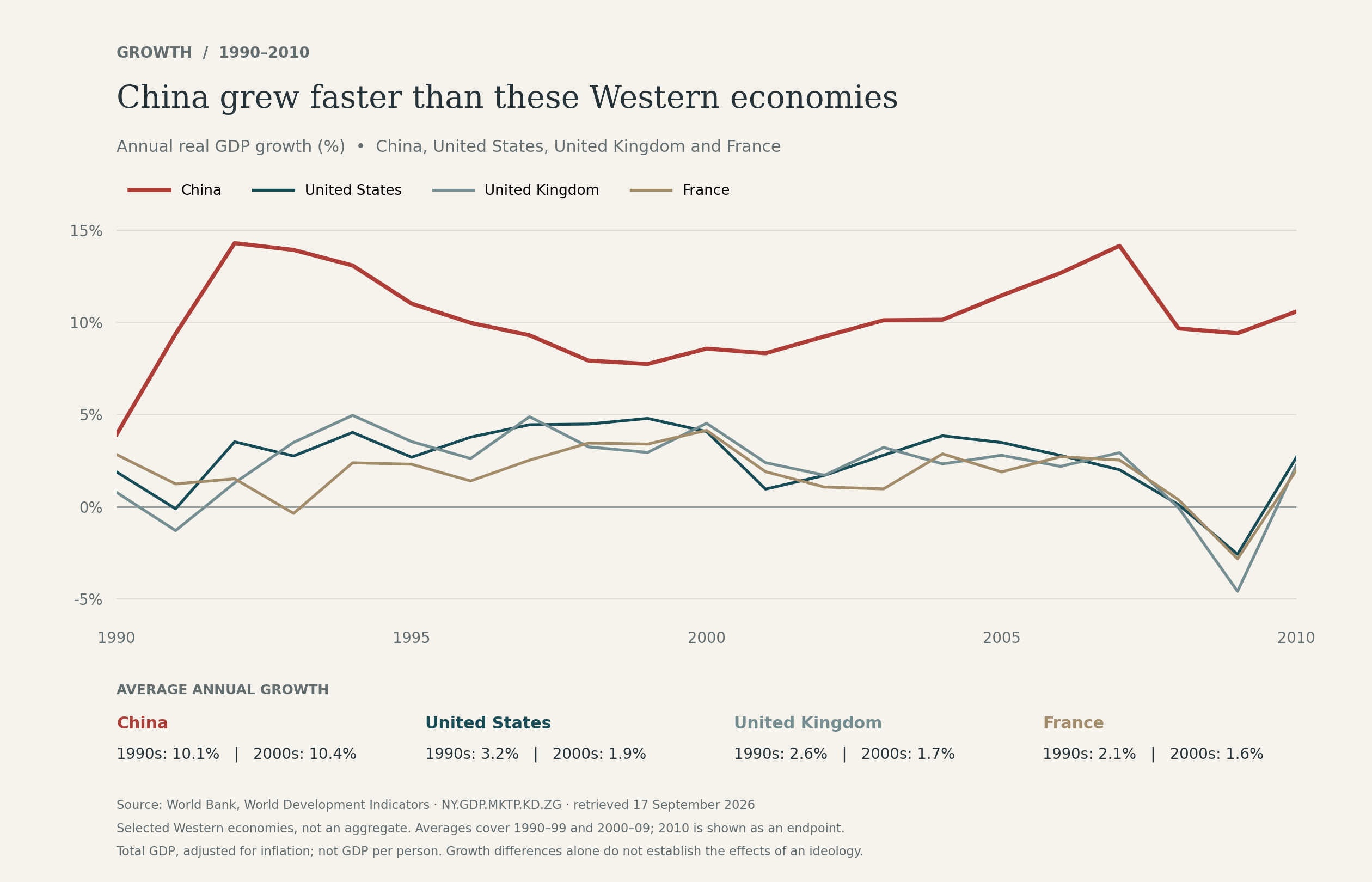
In the face of underwhelming and uneven growth, neoliberalism started to lose its sheen, especially among those who became aware of how they were getting left behind. It couldn't be polished up by neoconservativism, evangelical Christianity, War on Terror militarism, or any of the other patterns that emerged to fill the value-void of a system that only worshipped property and markets. In the end, the ground was made fertile for a backlash and a switch to the various hybrid systems that persist today, which we might call state capitalism – a blend of non-liberal limits on free trade (such as chip export controls), state ownership and control of companies (such as the US stake in Intel), and the primacy of industrial policy (as seen in recent calls for top-down control of artificial intelligence R&D), awkwardly mixed with neoliberal legacies like flexible labour markets and priority protection for the banking sector.
From patterns to purposes
So far, all this makes sense. Where I began to lose my way with A Brief History of Neoliberalism, and its possible application to issues of AI sovereignty, was the point where it delved into Harvey's idea that there are actually two ways of understanding neoliberalism: firstly as a programme for general prosperity, based on the doctrines of Hayek, Friedman and others, and secondly as a deliberate political project to serve class interests.
This idea of a political, purposeful kind of neoliberalism crystallises in Harvey’s narrative of what he and others have called the “Wall Street–Treasury–IMF complex”. He says that agents of neoliberalism repeatedly “orchestrated, managed, and controlled” debt crises in developing countries in ways that consistently redistributed assets from the poor to the rich.
In Harvey’s telling, Wall Street banks helped channel large volumes of capital into countries like Mexico, pocketing deal fees and commissions along the way and creating hype. Then, at the start of any wobble, they fled en masse, knowing that they could rely on the US Treasury and the IMF to protect their loans. Finally, long-term IMF support was offered to these freshly impoverished countries on condition of extreme neoliberal reform, including the privatisation of key industries and utilities in fire-sale deals that were set up and exploited by the very same bankers who had profited from the original inflows.
While proclaiming its role as a noble leader organizing ‘bail-outs’ to keep global capital accumulation on track, the US paved the way to pillage the Mexican economy. This was what the US Treasury–Wall Street–IMF complex became expert at doing everywhere. - David Harvey, A Brief History of Neoliberalism, p. 162.
There’s evidence to support key parts of this narrative, particularly for the Mexican debt crisis of the mid-1990s, where close relationships between private bankers, the US Treasury Department and IMF officials were widely reported. But I’m less sure about the implication that debt crises were deliberately engineered, repeatedly and across different countries and continents, in order to be exploited.
This sort of distinction matters to me, because I’m coming to academic literature in the hope of getting away from the value-led, evidence-lite narratives that dominate the news and other forms of media. Ideally, I’m looking for something like Max Weber's Wertfreiheit – “value-freedom” – a mental space where people with radically different values can find common ground in logic, facts, precise language and analysis. So, at risk of being boring and lawyer-ish about it, I would break down Harvey’s narrative into three claims:
- Neoliberal policies were deliberately promoted to strengthen owners of capital.
- Institutions deliberately managed crises in creditors’ interests.
- The same actors deliberately created those crises beforehand.
The first two claims are supported by evidence, but the third claim is more extraordinary – extraordinary enough that it might require me to change my understanding of the ability of individual humans to conspire towards complex, multi-year goals like creating and then exploiting national debt crises with Oceans Eleven panache. And I can’t find extraordinary evidence in Harvey’s book to support it, or even to be sure that Harvey himself really believes it, despite his suggestive language about debt crises being “orchestrated”.
Now, more than twenty years after Harvey's book was written, I'm also not sure that the study of political economy has fully resolved this issue of pattern versus purpose. You can still, for example, find academics who refer to the "the neoliberal thought collective" or who write things like "the radical right wanted to put democracy in chains." Social science has received warnings about this sort of confusing language since as far back as Durkheim's The Rules of Sociological Method (1895).
Anyway, coming back to AI sovereignty, I’m left wondering how a political-economic analysis like Harvey’s would be useful to someone, such as a British trade official who must look after national interests while negotiating with a superpower’s officials and technology companies.
Such an official would perhaps not be in a wildly different structural position from a Mexican counterpart working three or four decades ago, tasked with opening up their own country to foreign investment. Harvey’s book would certainly provide such a person with knowledge they could use as ammo to shoot down tenets or assumptions of neoliberalism that creep into a negotiation, and which might threaten the UK with some repetition of Mexico’s experience.
But a key question would remain unanswered: while any negotiator may be wise to assume they’re dealing with a coordinated foreign political project rather than just a pattern among private companies and institutions with no overarching plan, how do we know whether this is actually true? Or more simply: how can we tell what we’re negotiating with?