
The people of Iceland, despite having built a modern and pragmatic economy based on fishing and metals, are said to still believe in faeries and elves. They collectively know these spirits as huldefolk, or hidden people.
I don’t know how much of this tradition is in earnest and how much is self-exoticisation to promote tourism (another pillar of Icelandic GDP), but it doesn’t really matter for the point I’m hoping to make.
Such mystical overlays are familiar to me from the Middle Eastern stories of djinn I listened to as a child, and more recently from my experiences in the field of quantitative trading. And that’s where it starts to get interesting.
In systematic trading, where you expect to find cold logic, data and algorithms, you instead encounter halls of mirrors, voyages into the psyche and, above all, wizards.
Jack Schwager: Do you remember your worst losing week?
Mark Weinstein: I haven’t had any losing weeks during that time, but I have had some losing days.
Jack Schwager: That is an incredible statement. How can you be sure that you are not simply forgetting about a few weeks when you lost money trading?
Mark Weinstein: The reason I am sure is that I remember all my losses.
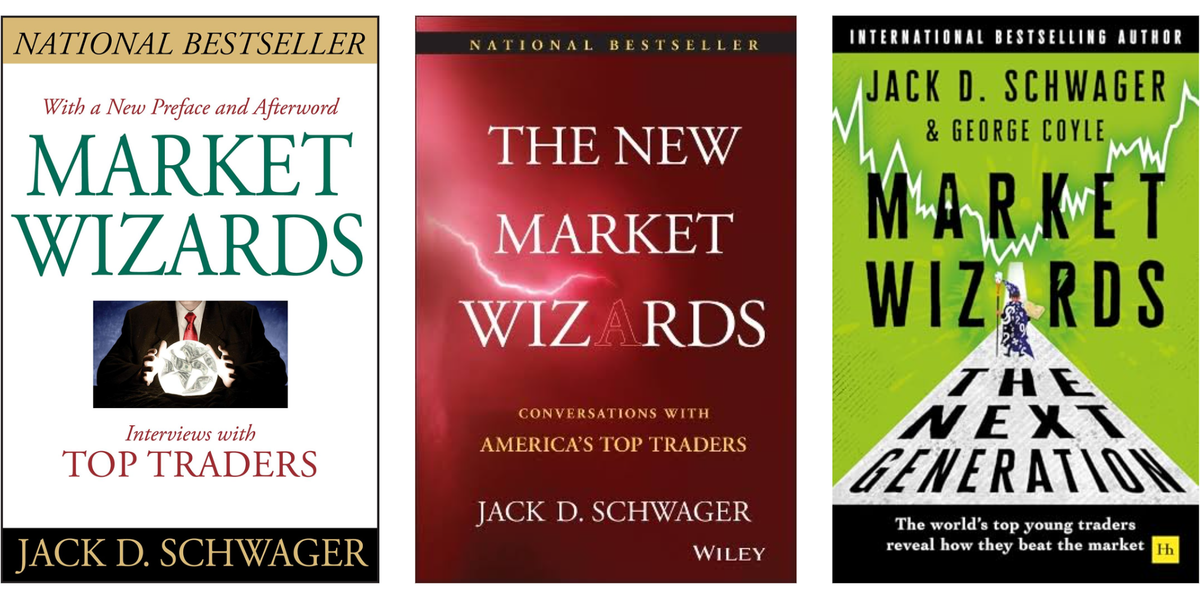
When I first started being involved in trading and managing other people’s money in 2018, I read Jack Schrager’s Market Wizards: Interviews with Top Traders – a book which by then was already forty years old. I quickly it followed it up with two more books in the series, finding some kind of catharsis in the blunt, non-corporate, hindsight-blessed recollections of other people who had been in the same position as me. I didn't spend much time wondering whether those narratives were technically true.
Mark Weinstein, quoted above, was a real estate broker who started trading with great success in the 1970s and who claimed in the book that 99% of his thousands of trades were profitable. This claim has since been met with skepticism.
I don't see why Weinstein would fib. I was and still am inclined to take him at his word. This is not the same thing, however, as taking his word at face value – at least, not in the way that others have. For example, I’m not sure that he ever claimed to be a wizard, despite the context in which his claim was published.
This brings us to one of three key concepts that I think Market Wizards helps a reader to decipher and appreciate, so long as it is read alongside other books that offset its imbalances:
#1: Skill is something we see regardless of whether it’s there
Market Wizards is an unwittingly perfect illustration of survivorship bias, luck-attribution bias and a number of other behavioural biases that constantly bedevil investing.
If you plot a distribution of profits of a sample of traders with similar strategies and abilities, you’ll get something like a normal curve. Except, it won’t exactly be a normal, bell-shaped curve – it will have fat tails on either side. Purely as a consequence of luck, or randomness, there’ll be many traders in the left-hand tail who get wiped out by losses and never heard from again, while those in the right-hand tail get rich and get interviewed. The chart will be symmetrical, but the storytelling won’t.
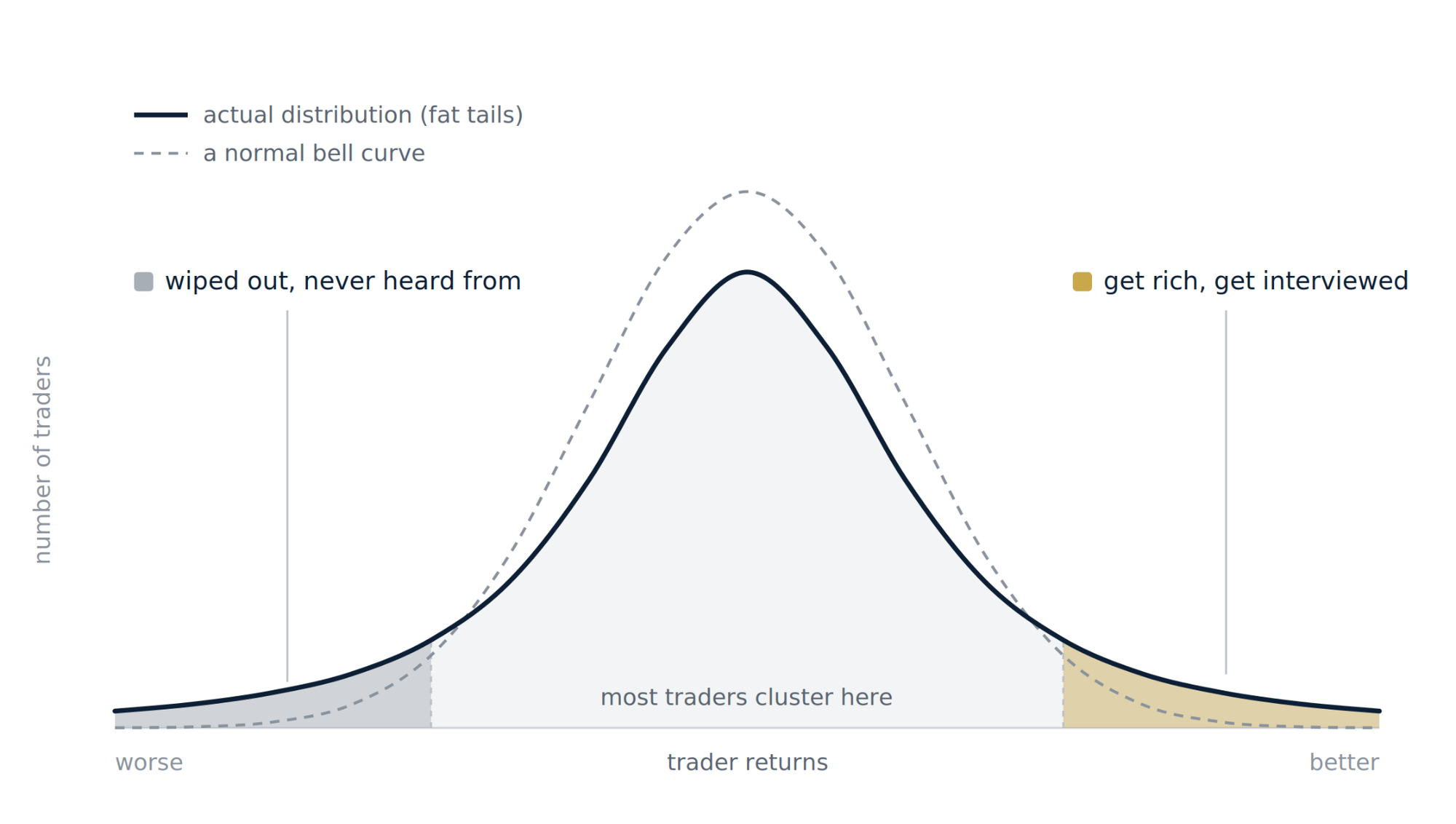
Market Wizards is therefore most valuable when read alongside, and used as an illustration of, a book like Nassim Nicholas Taleb’s Fooled by Randomness. You get the sting and then the antidote. You end up understanding just how hard it is to stop being biased against luck, even after you’ve learned that such a bias lives inside us all.
#2: Profitable trading exploits market inefficiencies, and history is how you learn to spot them
If you start with a classic book like Reminiscences of a Stock Operator, written in the 1920s, and then go through the Market Wizards series, you'll end up with a trading history that covers a good chunk of the 20th Century. Focus on certain details and you'll see that this is largely a history of how market inefficiency has evolved over time.
You’ll read interviews with traders who started out in shady boiler rooms, who gained an advantage by positioning themselves upstream on the flow of information, and who double-timed as both traders (trading for themselves) and brokers (trading for others).
Stuff like that shouldn’t happen in regulated markets, but it happened back then and it still happens now. In fact, once you learn to recognise it, you quickly suspect that it happens more in the 21st Century than it ever did before – thanks to conflicts of interest between modern exchanges and their customers, bot-driven wash trading and other high-tech versions of the same old tricks.
#3: Strip away the mystique and what's left is trend-following, which actually works
Let's take a look at one last quote:
Jack Schwager: I would assume, given the consistency of your success as a stock investor for over twenty-five years, that you don’t think very much of the random walk theory.
William O’Neill: The stock market is neither efficient nor random. It is not efficient because there are too many poorly conceived opinions; it is not random because strong investor emotions can create trends.
The magic word here is “trends,” because I suspect that many if not most of the successful traders interviewed by Schwager were involved in trend-following strategies to some degree, even if this is barely touched upon in the books.
In other words, those traders were capitalising on the well-reported tendency of stocks that have gone up in price to keep going up in price. This has been one of the most sustained and most mined market inefficiencies in history. It has fed many of the biggest quant funds – including those that have given the impression of having highly sophisticated algorithms, whereas in fact those algorithms could largely be written on the back of an envelope. Trend is huldefolk: something that should not exist, yet it does.
So, perhaps the biggest benefit of reading Market Wizards is that it’ll lead fledgling traders to the phenomenon of trend-following as possibly the only realistic way of getting anywhere close to the results those wizards describe.
Perhaps that sounds unrealistic. But this is the age of AI, and what better use of an AI coding tool than to 'vibe-code' your own trend-following trading bot? All that’s needed is a reliable source of price history (such as the free data available from Yahoo Finance), a source of trend strategies (Robert Carver has published some good ones), plus an API-friendly exchange to run the bot on, and finally some initial capital. Pretty soon you’ll be able to target a reasonable ratio of return to risk.
Just don’t be shocked if, before you reach that destination, the faeries and elves lead you on a merry dance of overfitting, data mining and in-sample forecasting. Don't be surprised when you meet all the biases you were sure you'd be able to avoid – the conviction that you're too smart for them being the most stubborn one of all. And whatever happens, don't expect a 99% win rate.